Surface Variants
Rolling out a new model, provider, or guardrail posture usually means redeploying a client or creating a parallel endpoint. Surface Variants let any Surface carry more than one behaviour behind the same route, so callers do not need to change the base URL they use. Roll out a model with a canary split →
Surface Variant
A Surface Variant is a named variation on a base Surface, selected through a route-level alias such as {route}$alias/..., without creating a separate Surface record. It can expose a different provider, model, rate limit, Prompt Guard, Judge, Jury, OPA policy, or set of Inputs elements (Audio File, Audio Stream, Image File, and Document File), without a second Surface to keep in step with the first. A voice or vision variant can therefore accept audio or images while the base Surface accepts text only.
A variant keeps its own copy of the settings it covers, so a later change to the base Surface does not flow into it. Each variant has its own name, URL alias, and description, and administrators select the variant they want to edit in the Surface editor. Because it keeps the base Surface’s identity and routing fields, it is reached through the same base route and observed under the same metrics. The base Surface and each variant are kept separate, so concurrent requests cannot reuse another variant’s provider or cached answer.
Test changes before promotion
Variants support development, staging, and production postures; tier-specific access such as free and pro; progressive rollout; and dual-persona A/B tests.
For example, an administrator can create a variant from a production Surface, change it to use a new frontier model or stricter guardrail, and validate the result without affecting production callers. Traffic addressed to the base route keeps using the base configuration, while callers that address the variant alias use the new posture. When the change is ready, promote the variant to become the default. New traffic arriving at the Access Point then uses the promoted configuration without changing the route or breaking existing callers.
Selecting a variant automatically
A client can address a variant explicitly with $alias, but a surface can also select one automatically, using two mechanisms that apply before the model is called:
| Mechanism | How it selects |
|---|---|
| Routing rules | An ordered list of rules on the surface’s Router element, each matching a request header, a top-level body field, or an attachment type (image, audio, document, or realtime voice), and routing to a variant. The first matching rule wins. |
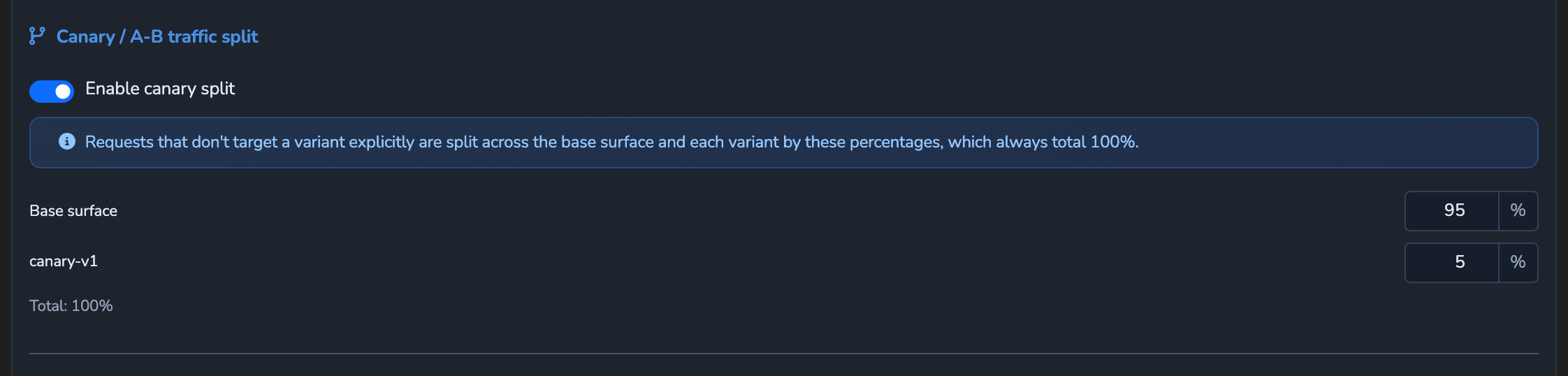
| Canary split | A weighted percentage split across the base surface and one or more variants, so full configurations can be compared by percentage of traffic. |
A canvas variant switcher lets you pick which variant to edit. Routing rules live on the Router element, and the canary split lives on the surface’s own configuration panel:
Which selection mechanism wins
For a chat request, an explicit $alias in the route wins first. If none is given, the first matching routing rule wins. If no routing rule matches, the canary split applies. A request that none of these selects goes to the surface’s default: the base Surface, or the variant promoted to default. A realtime voice session is routed differently: it goes to the variant named by the first Realtime voice (WebSocket) routing rule, and otherwise to the surface’s default. See Inputs and modalities →.
Why this matters
- Routing rules let you tier traffic without redeploying a client, for example routing a
X-Tier: proheader to a better model, or a batch-flagged request to a cheaper one. - Canary splits let you dark-launch a new guardrail posture or provider at a small percentage of traffic and watch its cost, latency, and rejection figures before promoting it to every caller.
Both are measured per variant in Observability →, so a rollout’s effect is visible from the first request. Once a variant proves out, it can be promoted to become the surface’s new default through the same variant controls used to create it, closing the loop from experiment to standard behaviour.
Turning canary off is non-destructive: routing stops immediately, but the stored split percentages and the variants themselves are left untouched, so re-enabling restores the previous split. Routing rules work the same way: turning off Enforce routing on the Router element stops rule-based routing and keeps the rules.
Related
- Surfaces: How a variant relates to its parent surface.
- IDE Surface: A surface type that can use variants for its own governed model menu.
- Resilience and caching: How a load-balanced pool differs from a routing rule or canary split.
- Observability: Where per-variant metrics appear.
- LLM drift detection: How replaying a surface’s captured traffic through a candidate variant checks a change against a baseline before it takes live traffic.
Glad to hear it. Thanks for letting us know.
Sorry to hear that. Thanks for letting us know.