Create your first surface
By the end of this guide, you will have an Agent Surface that accepts requests from an AI agent and forwards them to a backend service of your choice.
Prerequisites
- You are logged in to the dashboard.
- A backend service with a publicly accessible URL for the gateway to forward requests to.
- No backend yet? Use the Echo server as a test target. Start it locally and expose it publicly using a tunnel tool of your choice.
Steps
Start a new surface
Navigate to Surfaces in the sidebar.
Select Add Surface.
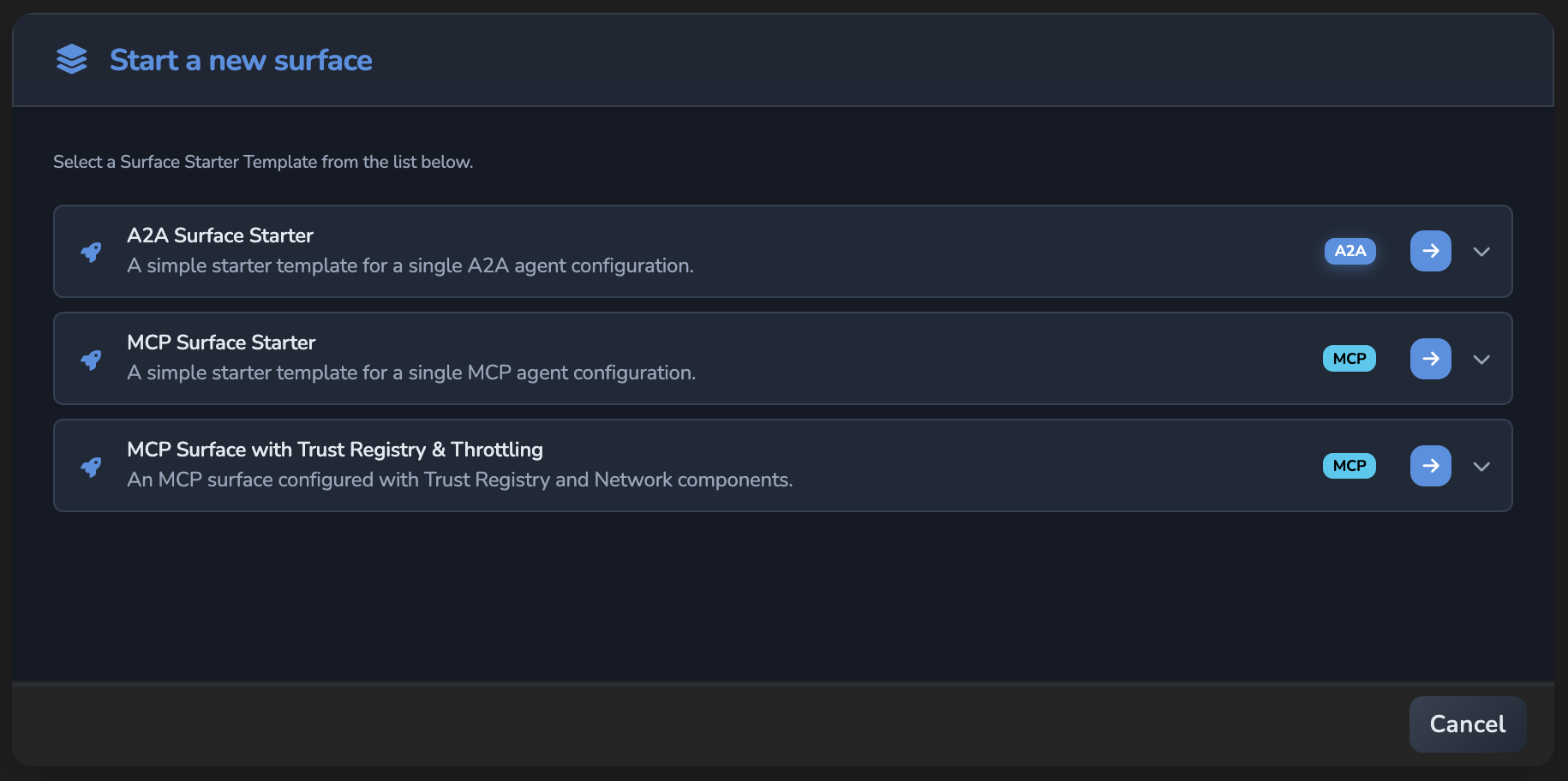
The Start a new surface dialog shows a list of starter templates. Each entry shows the template name, a short description, and its protocol badge. Select an A2A starter template for this guide.
The surface builder opens with the canvas already populated from the template.
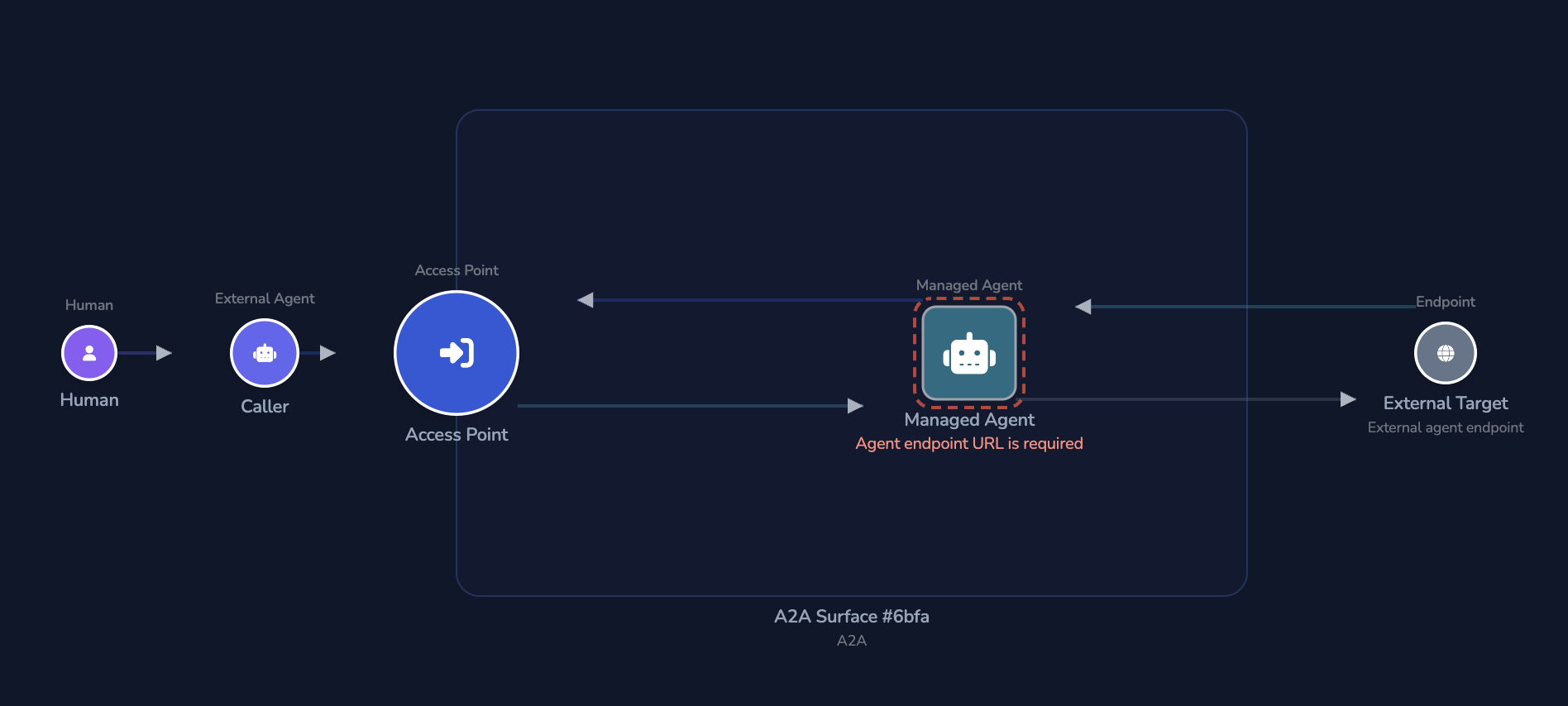
The surface is given a default name automatically. To update it, select the blue Surface container on the canvas. The Name field is in the settings panel that opens on the right.
Configure the Access Point
The Access Point element defines how incoming traffic reaches the surface. Select it in the canvas to open its settings panel.
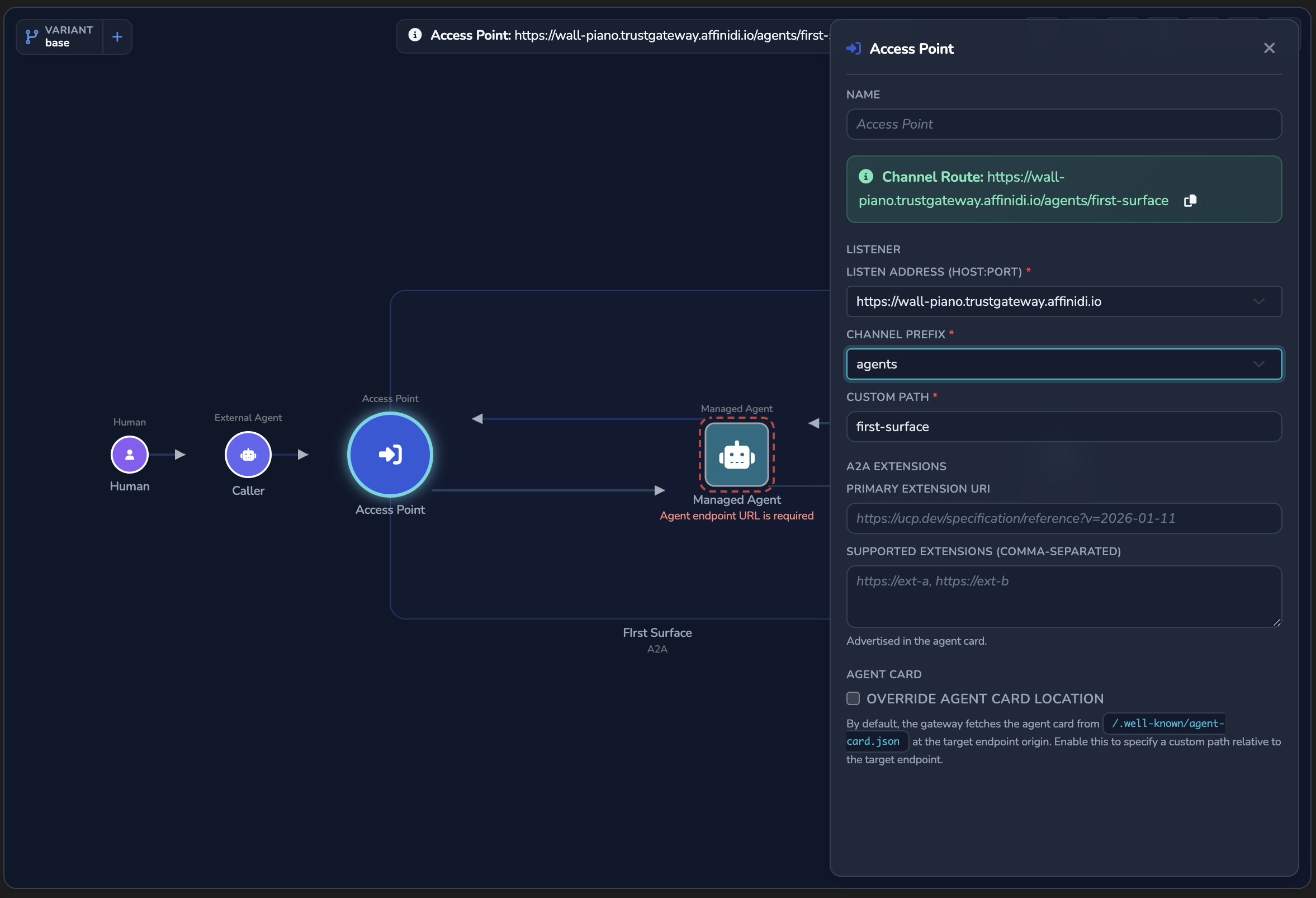
Under Routing, set the following fields:
| Field | Value for this guide | Notes |
|---|---|---|
| Listen Address (Host:Port) | (auto-seeded) | Pre-filled from your gateway instance configuration. Accept the default. |
| Surface Prefix | (auto-seeded) | Pre-filled from your gateway instance configuration. Accept the default. |
| Custom Path | first-surface | Identifies this surface in the full route. The auto-seeded value is a random two-word path. Update it to something meaningful. |
The Channel Route banner at the top of the panel shows the composed full URL: the listen address, surface prefix, and custom path combined. Copy this URL. You will use it in Step 5.
Configure the Managed Agent
The Managed Agent element forwards requests to your backend service. Select it in the canvas to open its settings panel.
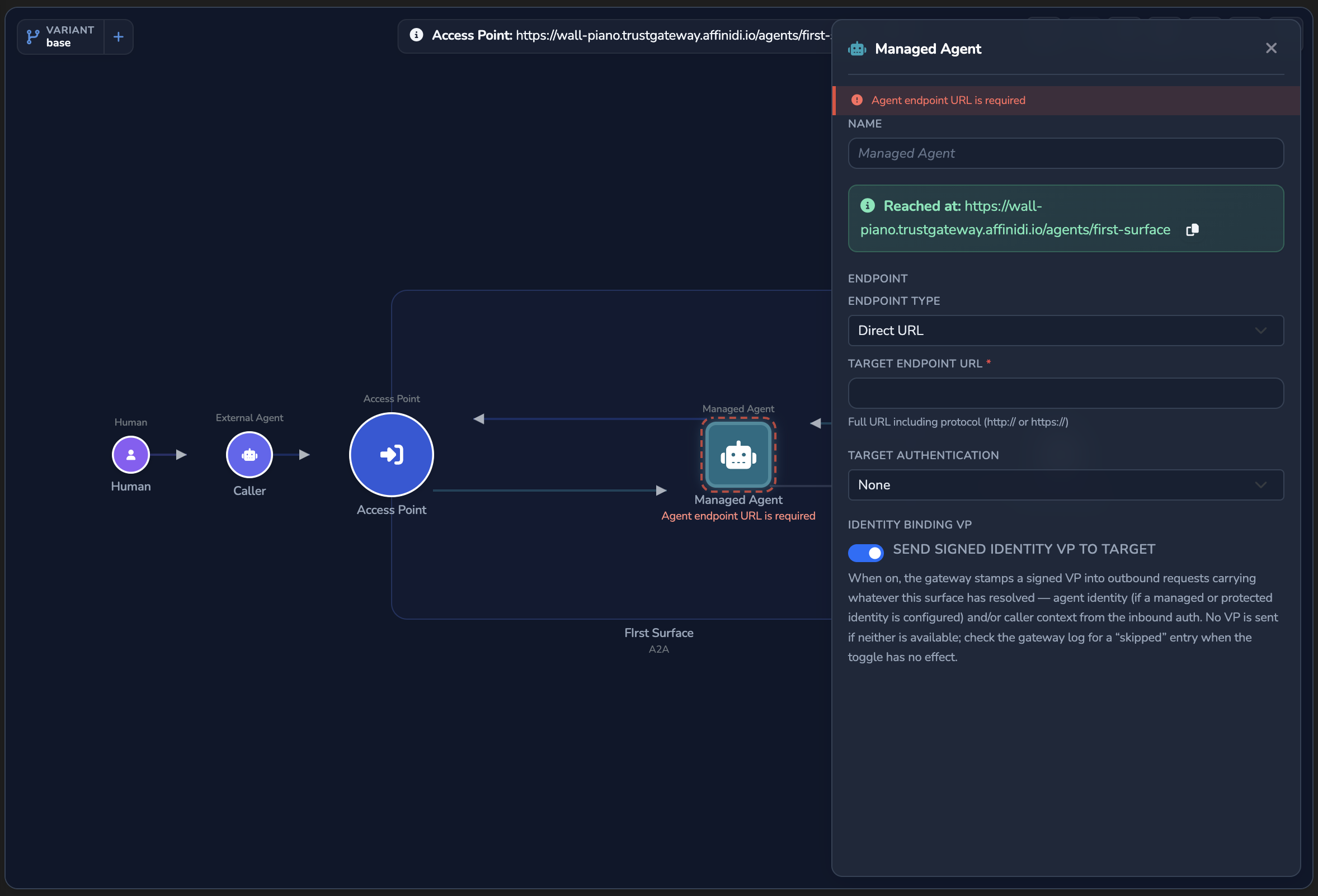
Set Target Endpoint URL to your backend service’s publicly accessible URL.
For a hosted gateway, localhost resolves to the gateway’s own host, not your machine. If your backend is running locally, expose it through a tunnelling tool and use the public tunnel URL here instead.
The Reached at banner shows the same composed URL as the Channel Route — the full address that requests must be sent to.
If required fields are missing:
- Visual alerts appear.
- Elements are highlighted.
- The Elements tab in the sidebar shows incomplete configuration.
Save the surface
Select the green ✓ button in the sidebar to save the surface.
- The surface is saved immediately.
- No restart is required.
A success notification confirms the surface was created, and you are returned to the Surfaces list where the new surface appears.
Send a test request
Use the URL from the Channel Route banner on the Access Point element (Step 2). Replace <YOUR_GATEWAY_HOST> with the listen address and <YOUR_SURFACE_PATH> with the composed path, or copy the full URL directly into the command below.
curl -k -X POST "https://<YOUR_GATEWAY_HOST><YOUR_SURFACE_PATH>" \
  -H "Content-Type: application/json" \
  -d '{
    "jsonrpc": "2.0",
    "method": "message/send",
    "id": "test-001",
    "params": {
      "message": {
        "role": "user",
        "messageId": "msg-001",
        "parts": [{ "kind": "text", "text": "Hello from the quickstart" }]
      }
    }
}'The -k flag disables TLS certificate validation. It is appropriate for initial testing against a local or development gateway, but must not be used in production.
If using the echo server, a successful response returns 200 OK with a JSON body containing the echoed method, path, headers, and body. The full request is also printed to the echo server’s terminal. For your own backend, a successful response depends on your service.
Confirm
Select the Monitoring tab in the surface detail page. You should see a request entry recorded for the test you sent in Step 5.
Troubleshooting
| Symptom | Likely cause | Fix |
|---|---|---|
400 Bad Request on create | A required field is missing. | Ensure Listen Address, Surface Prefix, and Custom Path are set on the Access Point element (Step 2), and that Target Endpoint URL is set on the Managed Agent element (Step 3). |
404 Not Found | The URL in the curl command does not match the Channel Route. | Copy the exact URL from the Channel Route banner on the Access Point element and retry. |
Connection refused | The gateway hostname or port in your command is incorrect. | Confirm the URL uses the correct listen address shown in the Channel Route banner. Contact your administrator if the gateway appears to be unavailable. |
502 Bad Gateway | The target endpoint is unreachable from the gateway host. | Confirm your backend is reachable from the gateway. For a hosted gateway, localhost is not accessible. Expose your backend through a tunnel and update the Target Endpoint URL on the Managed Agent element (see Echo server for an example). |
401 Unauthorized | Unlikely to come from the surface itself: a Caller Context element no longer rejects a missing or invalid credential on its own. Check whether your target backend requires its own authentication. | Confirm the target endpoint’s authentication requirements, or continue to Add identity and access control to add caller authentication with an explicit policy. |
Next steps
- Add identity and access control: Continue the tutorial with policy and identity controls.
- Surfaces: Understand protocols and request routing behavior.
Glad to hear it! Please tell us how we can improve more.
Sorry to hear that. Please tell us how we can improve.
Thank you for sharing your feedback so we can improve your experience.