How Meeting Place works
Meeting Place is an implementation of Affinidi Messaging that leverages the DIDComm v2.1 protocol, built on top of Decentralised Identifiers (DIDs). Unlike traditional identifiers such as email addresses or phone numbers, DIDs act as both the identity and the communication endpoint, enabling secure, private, and anonymous connections between parties. This approach keeps identity ownership with each participant, providing confidentiality and integrity in message exchange.
Key features
Multi-DID identity
Each connection generates a unique set of DIDs, keeping interactions in separate privacy contexts across different relationships.
Consent-gated connections
Connection requests require the publisher's approval before a channel opens, preventing unsolicited inbound messages.
Private peer discovery
Participants publish connection offers via the Control Plane API. Others claim offers with a passphrase; the publisher approves before messaging begins.
DIDComm individual messaging
Encrypted one-to-one messaging over DIDComm v2.1 channels with presence indicators and delivery receipts.
Matrix E2EE group chat
Native end-to-end encrypted group rooms with persistent history, rich attachments, reactions, and message editing via Matrix transport.
Audio and video calling
LiveKit-powered calls in Flutter apps using Matrix RTC signalling and per-participant end-to-end encryption.
Verifiable credential exchange
Issues and exchanges Relationship Cards (R-Cards) and Verifiable Relationship Credentials (VRCs) over DIDComm, with optional Human ZKP liveness proof.
Key components
Identity
Unlike traditional chat apps that use email or phone numbers, Meeting Place lets each participant choose the contact card they share with each connection, and every connection gets DIDs of its own.
For a direct connection, the Meeting Place SDK creates these DIDs:
| DID | Method | Created | Used for |
|---|---|---|---|
| Offer DID | did:key | By the publisher, once per offer. | Receiving acceptances of that offer. It is one-off and leaves the mediator’s access list after use. |
| Accept DID | did:key | By the acceptor, once per acceptance. | Receiving the publisher’s approval. It is one-off, like the offer DID. |
| Channel DID | did:web | By each participant, one per channel. | Sending and receiving the channel’s messages. |
Each connection established with another participant, whether direct or in a group chat, generates a unique set of Decentralised Identifiers (DIDs). This dynamic DID assignment enhances user privacy by separating identity contexts across different interactions.
Example:
- Alice and Bob connect directly using professional identities for a project.
- Each participant gets a channel DID of their own for that connection.
- Later, Alice joins a separate group chat for another project using the same professional identity.
- Alice gets new DIDs for that group, separate from the ones she uses with Bob.
Because DIDs aren’t reused across connections, each conversation stays separate.
Discovery
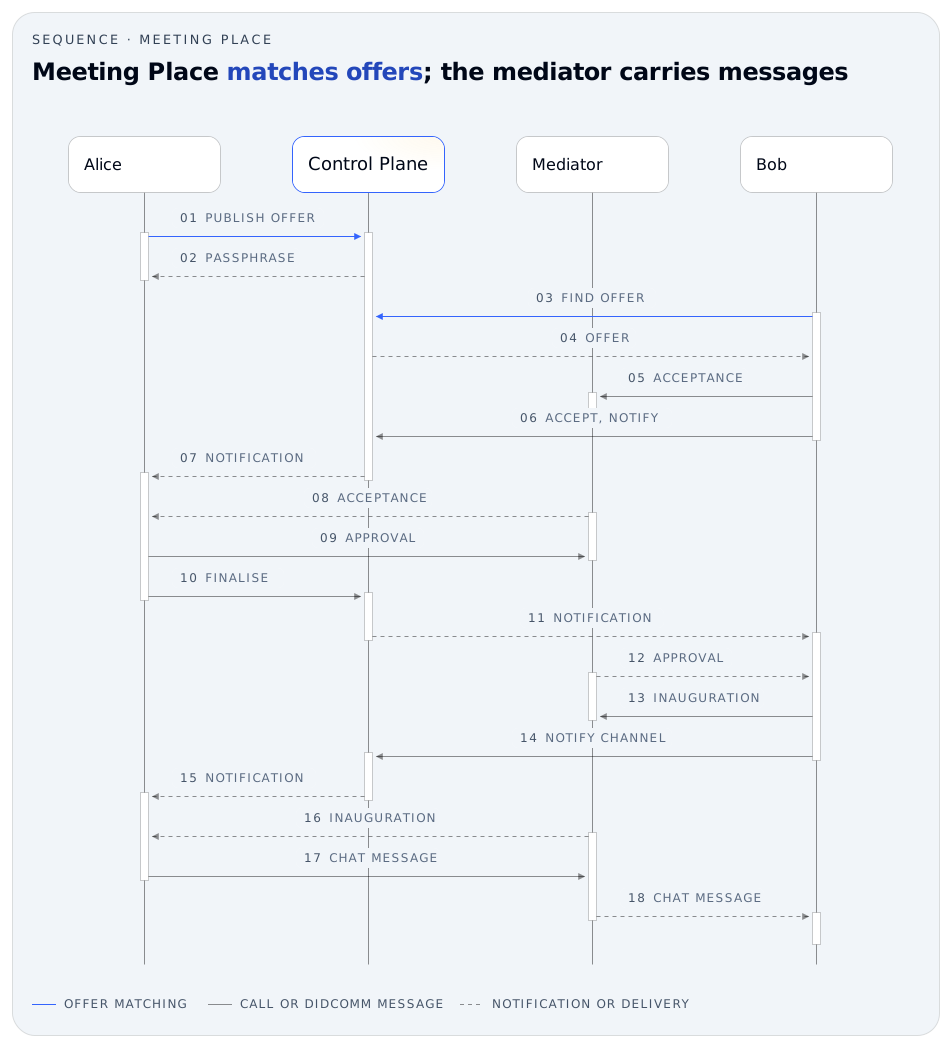
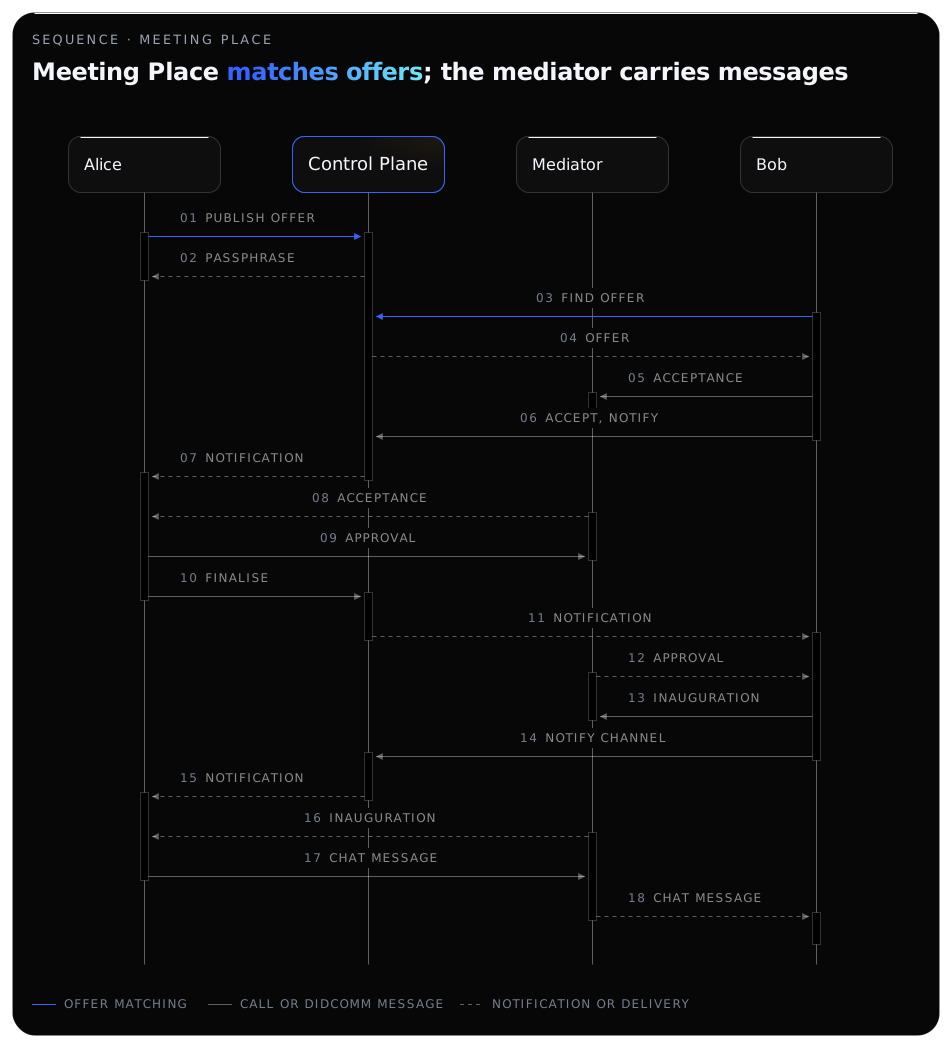
The Control Plane API enables discovery and secure channel creation using DIDComm v2.1. Participants can publish a connection offer or invitation, with the contact card they choose (for example, a gaming profile), for direct or group chat.
An invitation includes a description, validity, and optional vCard details.
Other participants claim the invitation using a passphrase, sending a connection request to the publisher. The publisher must approve the request before a secure channel is created.
The control plane handles discovery, matching and notifications. The acceptance, the approval and the channel’s messages travel as DIDComm messages through the mediator, as the diagram at the top of this page shows. When the channel is established, each participant has a channel DID of their own, and the one-off offer and accept DIDs are retired.
Meeting Place SDK
The Meeting Place SDK is a suite of composable Dart and Flutter packages. A minimal deployment needs only meeting_place_core and meeting_place_chat for DIDComm individual messaging. A full Matrix deployment adds meeting_place_matrix for group rooms and meeting_place_livekit_flutter for audio and video calls.
The Meeting Place SDK also leverages other Affinidi open-source SDKs, such as DIDComm for Dart, which sends DIDComm messages, and SSI for Dart, which manages decentralised identity and associated cryptographic keys.
What’s next
Glad to hear it. Thanks for letting us know.
Sorry to hear that. Thanks for letting us know.
Still stuck? Ask the community on Discord or contact us.